
The Art of High-Performance Heat TreatmentWhy Volcan Blades Refuses to Compromise
For an exceptional knifemaker, heat treatment is not an option — it is the soul of the blade. At Volcan Blades, we chose industrial heat treatment in a controlled atmosphere using ELTI belt furnaces. This guide explains the science behind that choice — and why it makes a concrete, measurable difference on every blade.
Decarburization: the silent enemy of your blade
When steel is heated to high temperatures in the presence of oxygen — in a conventional forge furnace or an unprotected home heat treatment — a destructive chemical reaction occurs at the surface. The carbon in the steel reacts with oxygen to form CO₂ that escapes from the part.
The Scientific Verdict
This loss of surface carbon, called decarburization, produces a blade with a skin softer than its core: a surface hardness that crumbles at the whetstone. Our furnaces saturate the environment with neutral gases (Nitrogen or Argon), ensuring every milligram of carbon remains locked in your knife’s structure.
Stainless foil wrapping limits surface oxidation, but does not create a saturated atmosphere — decarburization remains partial. Without specialized equipment, the question is not whether your blade will be decarburized, but by how much.
Desensitization: when slow cooling destroys stainless steel
Desensitization is the invisible risk of poorly controlled heat treatment on stainless steels. Hervé Sassoulas, research engineer (civil engineer from the École des Mines), documented the precise mechanism in the Techniques de l'Ingénieur.
Below a critical cooling rate (approximately 10 °C/s), chromium carbides and nitrides precipitate at grain boundaries. This phenomenon drops the free chromium content below the critical threshold of 10.5% — the blade loses its stainless properties from within, with nothing visible to the naked eye.
Only an industrial installation like our ELTI furnaces allows precise second-by-second control of this cooling rate, ensuring total protection against corrosion.
Hervé Sassoulas, civil engineer (École des Mines) — Techniques de l'Ingénieur
Achieving and maintaining 10 °C/s uniformly across the full length of a blade is a physical constraint impossible to satisfy with a home quench into uncontrolled-temperature oil. The consequence of too-slow cooling is invisible — until the blade starts to rust.
Controlled atmosphere: why forming gas changes everything
This is the technical line between professional and amateur heat treatment: the purity of the environment in which the steel hardens. Our belt furnaces use a reducing atmosphere of Nitrogen and Hydrogen.
Hydrogen acts as a molecular cleaning agent: from 300 °C it reduces metal oxides present on the surface. The blade emerges from the furnace in a surgically pure state — no scale, no oxidation, with the integrity of the machined edge perfectly preserved. Metallurgists call this a bright anneal.
Neither stainless foil nor protective coatings replicate this result. These methods guard against visible oxidation — they do not create an active reducing atmosphere.
DIY Method vs VolcanBlades ELTI Furnaces
| DIY Method | VolcanBlades ELTI Furnaces | |
|---|---|---|
| Atmosphere | Ambient air (oxygen present) | Nitrogen + Hydrogen (reducing) |
| Decarburization | High surface risk | Zero — carbon fully preserved |
| Chromium depletion | Possible with slow cooling | Impossible — quench speed controlled |
| Surface condition | Scale, oxidation | Bright anneal — surgical purity |
| Batch consistency | Variable part to part | Identical across entire series |
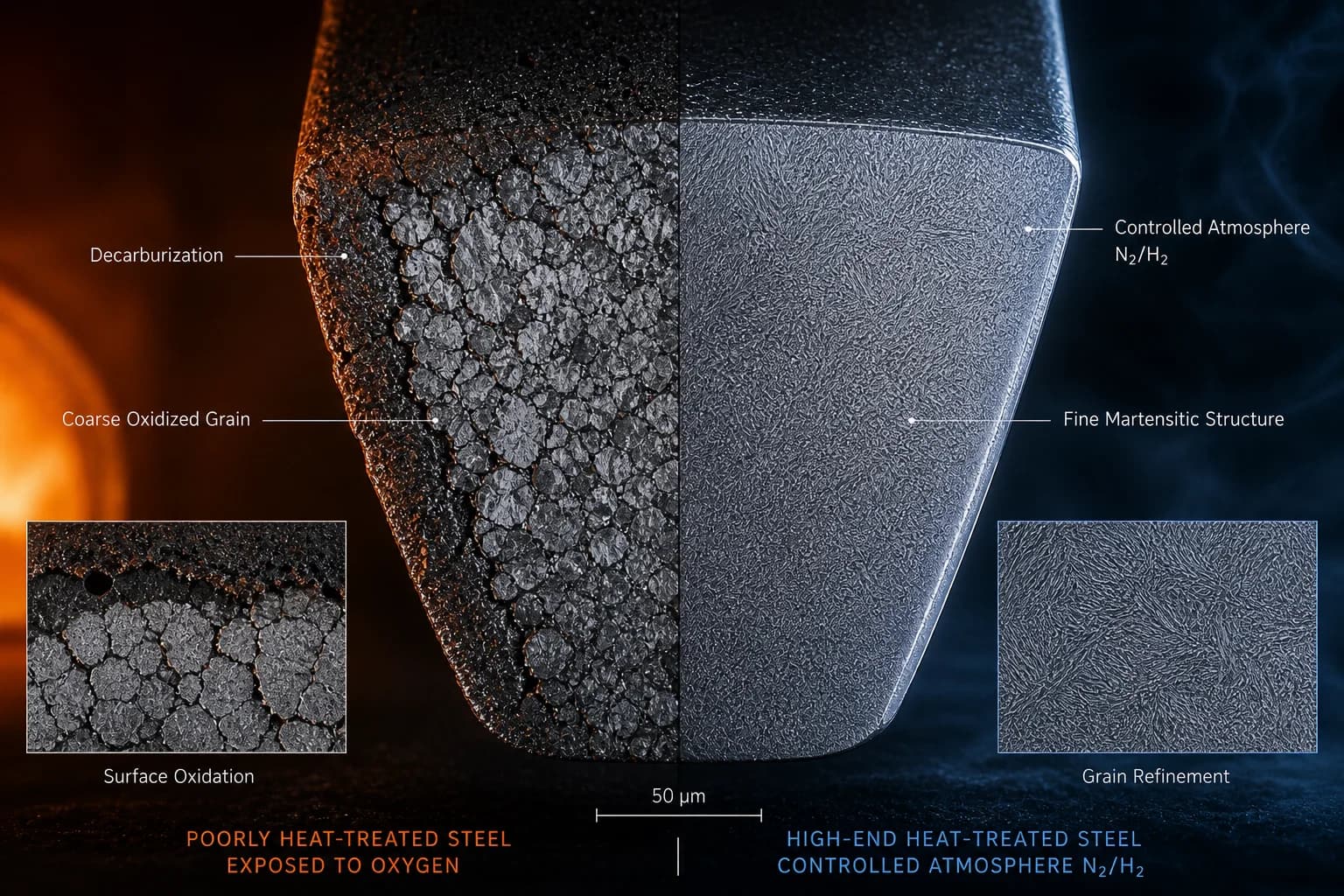
Visual comparison of both approaches: DIY method vs Volcan Blades continuous industrial line.
Conclusion: Volcan Blades Precision
By entrusting heat treatment to a continuous industrial line, Volcan Blades guarantees total homogeneity. Every blade undergoes exactly the same thermal cycle, validated by decades of metallurgical research.
It is this scientific rigor that allows our knives to exceed standards and deliver unmatched cutting edge retention.
Order with High-Performance Heat Treatment
Your DXF file + our industrial heat treatment = a blade at 60–62 HRC, without decarburization, without compromise. Instant quote, from 1 piece.